
Pomost Magazine, June 11, 2026
Where Sound Becomes a Story. A Conversation with Jan Elf Czerwiński

Interview conducted by: Serhiy Savchenko
I met Jan Czerwiński more than six years ago, practically at the very beginning of our gallery’s existence. Encountering the energy and pure passion that radiate from his music was a remarkable discovery for me. Exceptionally sensitive and noble in every gesture, yet at the same time strong in his convictions. One of my close friends, after listening to one of Jan’s concerts, once said: “The music of a healthy personality.” It is hard to imagine a more accurate description.
The fact that our gallery space gradually transformed into a kind of intimate launching point for young musical talents is largely thanks to Jan’s community-minded spirit and dedication. For several years, Jan Elf was the curator of one of our projects, “Hear the Image, See the Sound.” It was a project that best reflected his artistic explorations within the realm of intimate art and support for emerging musical talents. I was incredibly fortunate to co-curate this project with him. It remains one of the most fascinating musical initiatives I have ever had the opportunity to observe from close up.
Jan’s performances in our gallery, both solo and together with his friends and collaborators, have always filled our intimate venue. Thanks to Jan, we have met many wonderful musicians not only from the Tricity area, but also from other countries. He has always openly and warmly shared contacts from among his friends and artistic community.
Today’s conversation is something that deserved to be recorded a long time ago, because the work of Jan Elf Czerwiński certainly deserves it.
Was music your passion from childhood, or were you also drawn to other arts — such as drawing or other forms of creativity that might have competed with your choice?
Hmm… I think I realized quite quickly that visual arts were not my strongest side. Somewhere at the bottom of a drawer there is still a notebook filled with various doodles, mostly leaning toward street art, but it is nothing I would particularly like to show off. What I am most proud of is the concept for my own logo, whose realization was greatly helped by my dear friend Grzegorz Stanley — an example of a truly interdisciplinary and highly educated artist. I have always focused on what I do best, which is making music, and I greatly value contact with artists from other disciplines, especially when visiting Savchenko Gallery.
What quality do you value most in a person? And what quality, in your opinion, is the most important for an artist?
We are not paid for being ordinary. I believe that an artist should be, above all, creative and inventive — someone who creates and proposes new things. A bit like an engineer, but operating on a different plane. I admire artists who focus on technique and craftsmanship, constantly searching for new qualities in what they do. This is what allows us to discover directions that have never existed before.
In people, I generally value empathy, humility, and understanding. As an individualist myself, I try to respect another person’s space and life, and I think we would all benefit if more people were able to step into someone else’s shoes. That said, it is quite a passive way of approaching life, and the world — as we know — is incredibly diverse. Sometimes it may even be beneficial when someone is a little inquisitive, provided it comes from good intentions. I accept the mosaic of humanity as it is, trying to avoid focusing on its cracks.
Do you think the artist’s path is the path of a monk? Should an artist devote themselves entirely to their art, or, like everyone else, seek balance? How does it look in your case, and is it difficult to maintain that balance?
As many people, as many paths. Different things drive us, and different methods lead us to results. Now, as I am preparing to release my first album, I can clearly see how deeply it emerged from my own life — it is a collection of stories from the years that shaped me the most.
For many years, I tried to focus exclusively on creating, and it never really worked for me. Personally, I choose the path of drawing inspiration from other areas of life. I believe that family life, sports, work, and travel all have a great deal to offer. I like to catch an inspiration, feel something deeply, and then retreat into a quiet corner to transform that reflection into a carefully crafted piece of work that requires a great deal of time and concentration.
What is your relationship with technology in music? Do you see it as more of a friend than an enemy, despite the fact that many people fear it or approach it with distrust?
Ironically, despite being a specialist in performing with a loop station — a method of creating music that is clearly based on hardware — I do not feel particularly comfortable digging around in the world of software. I do not work well with computers and prefer to focus on ideas that emerge live and on music created in the here and now. The stage of programming music often becomes a moment of friction and resistance for me, something that can slow down or even halt the creative process.
In ideal circumstances, I would love to have an intelligent assistant who could handle all the technical aspects for me, allowing me to focus entirely on the material itself. Unfortunately, this is a complex issue, partly because music production is also a creative process. The choices made while shaping a sound through plugins, compression, equalization, and sound selection all influence the final result. I would not want someone else to replace me in that process.
I am curious about and eager to test new developments, while trying to devote as much time as possible to the very idea of a piece — an idea that I hope can be released into the world in its purest possible form.
The world today is full of anxiety. Just next to Poland, the war in Ukraine has been ongoing for almost five years, while conflicts continue to unfold in other parts of the globe. Do you sense these moods in contemporary music? And do you allow the outside world to enter your creative work?
Ukraine is very close to my heart, and I am saddened by the suffering we witness today — both around the world and just beyond our border. The message in my music tends to be more universal and less literal. So far, I have not directly referred to specific world events in my compositions, but that does not mean I fail to notice them or that they do not affect me. I would like my music to carry hope and comfort.
What do you feel when teaching people during workshops? What does educational work or leading workshops mean to you? Could you lift the curtain just a little and tell us what your workshops are like?
Every opportunity to share something that is important and valuable to me means a great deal, because it allows me to pass on the teachings of my own masters. I have received so much myself that I feel a desire to give something back.
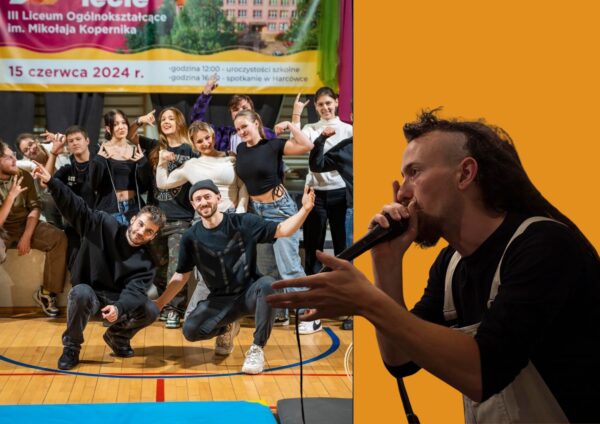
During my workshops, I create a beatbox choir with the participants, opening them up to the exploration of sound while also showing them how to use what they already possess. The fundamentals of beatboxing, humming, and creating soundscapes — we experience all of these things together and individually. I try to approach every participant as personally and individually as possible.
I know about your involvement in theatrical projects. How has your experience with theatre influenced your music and performances?
Theatre is an incredibly rich medium, and I love immersing myself in it, creating things that are new and unexpected. Ever since I began working on theatrical productions eight years ago, theatre has become a gateway for realizing musical ideas that do not always fit onto a concert stage.
That said, theatrical inspiration is definitely present in my concerts. Whenever I perform, I try to create a miniature theatrical experience on stage, paying attention to scenography, movement, and a certain sense of stage presence and gravity.
Beatbox is often perceived as something intuitive and “street-based,” while you work with highly complex musical structures. How do you connect these two worlds?
I come from the beatbox world, but I often wonder whether that world fully contains me within its boundaries. I would like to expand those boundaries, because beatbox, as both an idea and a community — a beatbox family — offers a valuable opportunity for people who may not yet have found their path.
What I love about beatbox is that, despite having a very low entry threshold, it is open to everyone, especially to people who may not have had an easy start in life. It takes very little to begin, yet the possibilities for growth are endless, and we are only now discovering what beatbox can truly become.
I draw on my own inspirations and musical reflections, unsupported by any formal musical education, and try to bring out what is most interesting within me. The same process is happening all over the world. Beatbox artists will undoubtedly surprise the world many more times.
If your sound or artistic style were described as a world of its own, what would be most important within it: rhythm, storytelling, emotion, or something else?
That is an interesting question! I think it is a little bit of everything. From a technical perspective, I certainly focus more on rhythm and percussion, but I also enjoy singing about what matters to me. When creating, I am guided by emotion and a desire to share what I feel. I try to ensure that there is some truth contained within the sound and that I remain as sincere as possible during my performances.
Tell us more about your upcoming workshops!
My most recent workshop took place on June 2 at Savchenko Gallery as part of the EDUKULTURA project, funded by the City of Gdańsk. It was an incredibly inspiring meeting, full of creative energy, openness, and the shared discovery of the possibilities that working with sound can offer. It became a space for encounters, exchange of experiences, and artistic growth.
I would like to thank all participants for their presence, energy, and trust. It was one of those events that stays with you for a long time and reminds you how much joy can come from creating together.
June 12 will be a very important day for me, because I am releasing my first album! My long-awaited EP, “Senbazuru,” will debut at the Fląder Festival in Gdańsk, and I am incredibly excited about this opportunity.
This season, people will also be able to meet me and find my records at many different events. It is especially worth mentioning the Polish Beatbox Battle, which I will once again have the honor of judging.
You are all warmly invited!