
MAGAZYN POMOST. 04/08/2026

Interview conducted by: Serhiy Savchenko
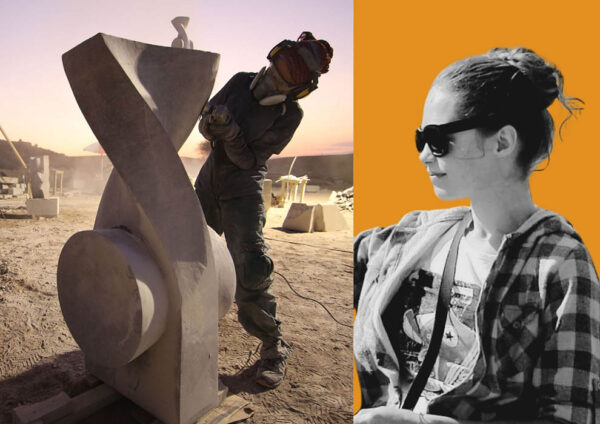
We met Olena Dodatko for the first time at one of the openings in our gallery. When she introduced herself as a sculptor, my reaction—mild surprise mixed with fascination—was probably something completely familiar to her. A delicate woman of slight build, at first glance, seemed entirely at odds with the image of someone who works with such a demanding and serious material as stone, and on a large scale at that.
Later, when I had the good fortune to get to know her work more closely, my artistic respect only grew. And once again I was convinced that art is not a story about physical strength. It is rather a story about sensitivity, inner discipline, a high culture of thinking, and an equally high level of education.
There is one more trait characteristic of true artists—the ability to keep developing, regardless of circumstances. In my view, Olena is exactly such a person: by creating her own art, she enriches the cultural environment of the Tricity; she lives, creates, and teaches others in our beautiful Gdańsk.
That is precisely what we talk about today with Olena Dodatko—her work, her methods and influences, and simply life itself.
Olena, you work mainly with stone. What is it about this material that you do not find in wood or metal? What fascinates you about this seemingly stubborn and hard medium?
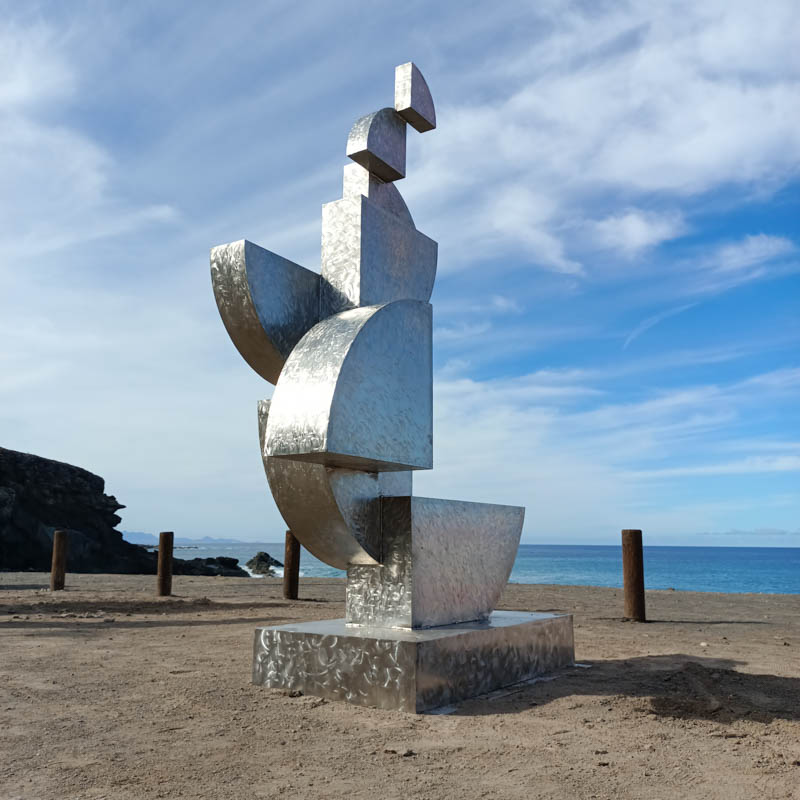
It is one of the oldest, strongest, and most durable materials in the world. By investing so much of my own energy in creating a work, I am confident that it will have a long life. For me, stone is a rather warm material—one you want to touch, to stroke. Metal, in my opinion, has an entirely different energy. It is cold, industrial, and unlike stone, not as durable. However, I am working with this medium more and more often. I am learning to sense its energy and discover its possibilities, because it has many advantages. Wood is also warm and pleasant to the touch, but it has its own requirements regarding storage and later care of the works. It is a material that is constantly alive—it breathes and cracks.
In your works, one often senses a dialogue between mass and void. To what extent is space the same material as the stone itself? Can void and fullness become opposites of sorts, a kind of vis-à-vis, or are they rather related in meaning and not antagonists to one another?
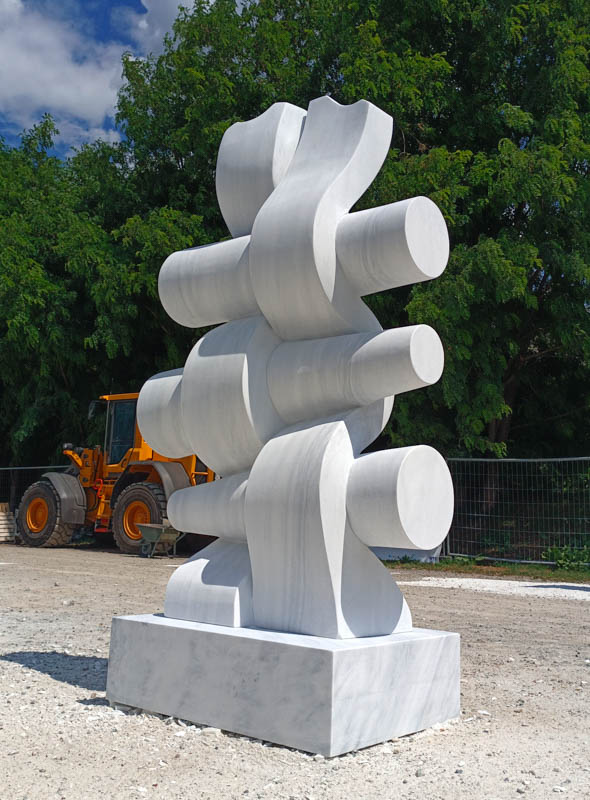
In my work I apply a principle introduced by our outstanding sculptor Oleksandr Archipenko. It was he who established that void and the space between forms are just as important as the mass, the fullness of the sculpture itself. Void allows one to emphasize form more effectively, gives it lightness, and adds more air to the sculpture. Interestingly, it also allows the sculpture to appear visually larger. In stone this works especially well: the more material you remove, the more the form begins to “work,” and the larger it appears visually. That is why I do not see void as the opposite of matter. One does not exist without the other. It is precisely their mutual interaction that builds the composition and gives the sculpture its final character.
Looking at your works, one immediately notices that abstract compositions prevail in them. Does this choice come from the material itself, or rather from your clear artistic stance—from the way you speak to the viewer?
Yes, in most cases, though not always. Since most of my works are large-scale sculptures, I believe that abstraction best combines with contemporary architecture. For me, abstract sculpture is more like an aphorism than a story. Each person receives it through the prism of their own experience and emotions. It seems to me that abstraction affects emotions more strongly than intellect, though both modes of reception are equally important. Of course, this is only my subjective opinion. Perhaps it is because, when creating works, I am guided above all by emotions, and only in the course of working do I begin to understand their meaning and realize what I actually want to say.
In many works, the motif of joining separate elements recurs. What does this “connection” mean to you—construction, human relationships, or something else?
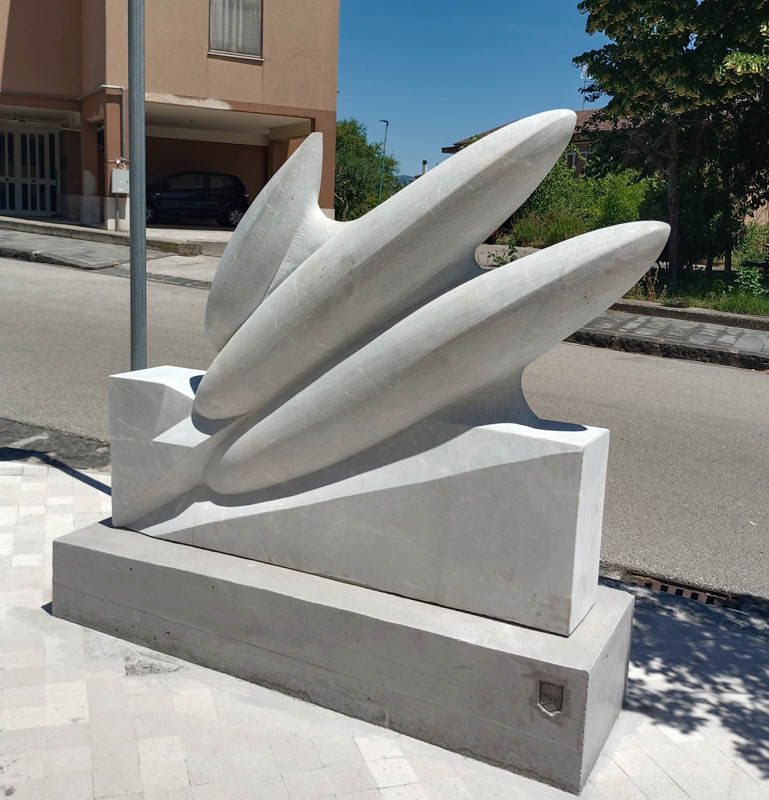
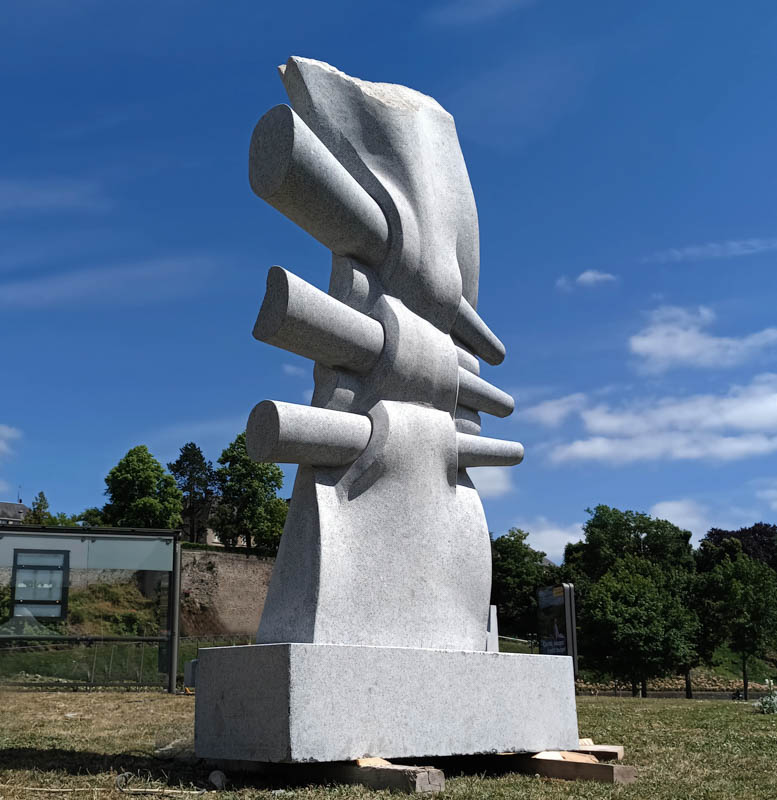
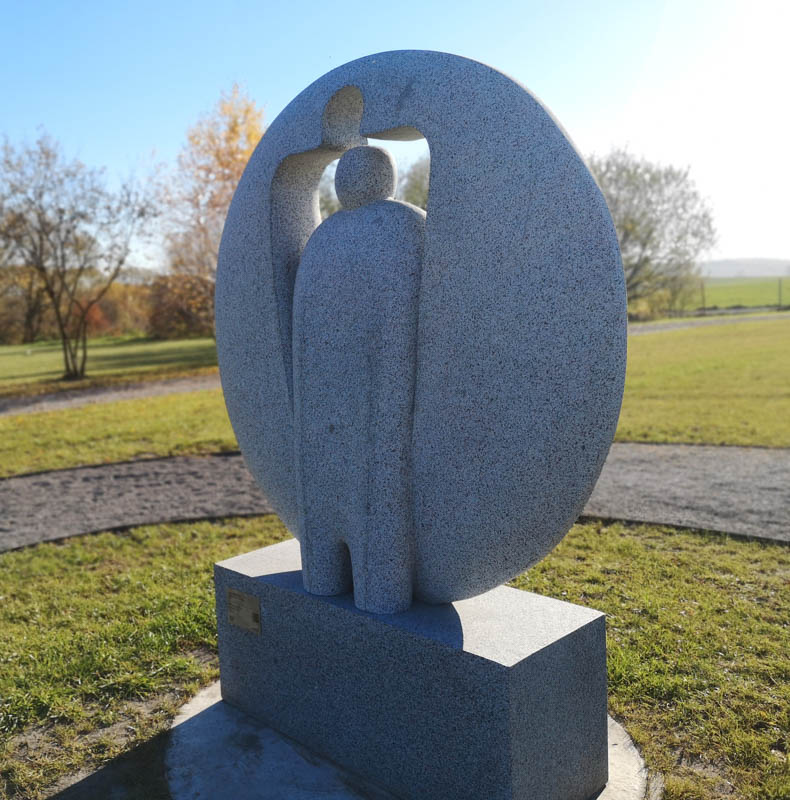
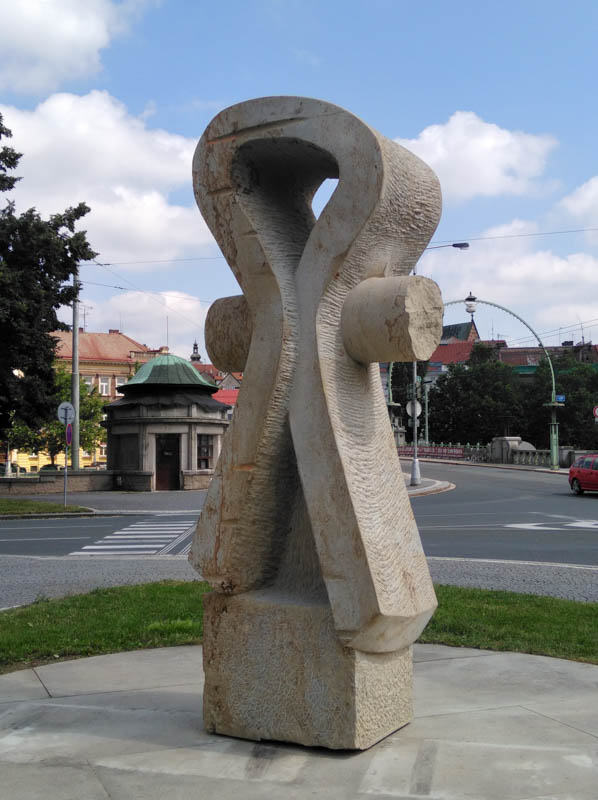
Above all, for me it is a symbol of support, human bonds, and the inner core that helps us maintain balance in our difficult contemporary world. I believe that every person needs a certain point of support—one that gives strength to move forward and not lose oneself even in the most difficult moments. That is what I think about in works such as “POINT,” “CONNECTION,” “POINT OF CONNECTION,” “INTERLACEMENT,” and others. For me, the inner core is what makes a person resilient. It may be family, a loved one, friends, a favorite job, faith, or a goal one pursues over many years. For each person this point of support is different, but it is precisely what helps us overcome difficulties, preserve inner balance, and not lose contact with ourselves.
You have worked and created in various countries around the world. Does your artistic language change depending on place, culture, or landscape? And can you point to a country or place that has become a true favorite for your creative work?
Yes, to a certain degree my artistic language changes depending on the country, culture, and place where the sculpture will live. Since I work not only with abstraction but also with generalized figurative form, each project requires an individual approach. For example, for Arab countries I more often choose abstract forms, because they better correspond to the local cultural context. In European countries I have greater freedom in choosing a visual language. The theme of the symposium, the location where the sculpture will be placed, the material, the scale of the work, and the time allotted for realization also influence the decision. That is why before starting work I always try to think everything through carefully and plan it in detail.
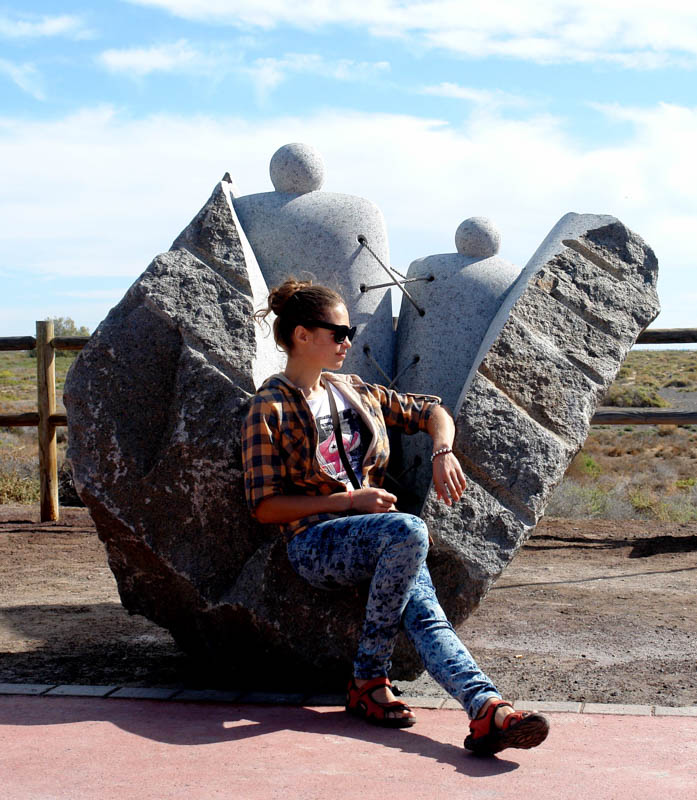
It is difficult for me to name one favorite country for creative work. Each has given me new experience, encounters with interesting people, and the opportunity to learn something new. Today most of my works stand on Fuerteventura and in Ukraine—so these places are special to me. I also remember Taiwan, Oman, and Turkey warmly. Each of these countries left a mark on my memory and gave me valuable experience.
Monumental sculpture always enters into dialogue with its surroundings, no doubt. How do you see this? How does this dialogue begin, how do you “activate” it, where do your interactions with space as the author of the work begin and how do they end? Do they end at all? Has it ever happened that the material itself dictated the final solution, forcing you to abandon the original idea? Or does it happen differently?
Yes, that is true. However, I do not always have the opportunity to see the location where the sculpture will be placed before I begin working on the sketch. Usually the final decision about the location of the works is made by the symposium jury, which selects projects for a specific site. Sometimes I receive photographs of the future location—and that helps a great deal in working on the project. It also happens that I can come to the symposium earlier, see the space, and choose the stone myself. That also significantly facilitates the work.
Of course, there have been situations when the material forced me to change the project. For example, the proportions of the stone block differed considerably from those assumed in the sketch. Then it was necessary to adjust the composition or the proportions of individual elements, but the initial idea of the work remained unchanged. And interestingly—very often the final result turned out to be even more striking than the original sketch.
During work, the material almost always suggests its own solutions. Sometimes one wants to leave part of the stone’s natural texture, sometimes to change the proportions of elements so that they better correspond to the form of the block. That is why one must know how to talk with the material and understand it. I always await the birth of each work at scale with impatience. Even having a finished model and a clear image of the sculpture, I know that the stone—its structure, size, and character—always brings its own corrections. That is why each work becomes unique.
You studied both in Kyiv and in Lviv. What fundamental differences between these art schools most influenced your formation? And one more thing—how do you feel in Poland? Is there a great difference between the artistic environment of Ukraine and Poland? If so, in what does it consist?
In Lviv I studied in the department of monumental and decorative sculpture, so great importance was placed on the relationship between sculpture and architecture as well as urban or park space. In Kyiv, the education was more oriented toward visual thinking and freedom of creative exploration, without limiting oneself exclusively to monumental or easel sculpture.
At the same time, the Academy of Fine Arts in Gdańsk played a very important role in my formation as a sculptor. Already during my studies in Lviv and Kyiv, in 2010–2015, I came here for student plein-air sessions and casting workshops. It was here that I discovered a different perspective on contemporary sculpture and understood how broad the concept of “sculpture” can be.
When full-scale war began in Ukraine, among the many countries that opened their doors to Ukrainians, I chose Poland not by chance. It was a country I knew fairly well, in which I felt comfortable, and in which I had professional contacts even before the war.
As for the difference between the artistic environment of Ukraine and Poland, it is difficult for me to comment on or generalize. In recent years I have worked a great deal at international symposia, so I more often meet artists from different countries than I spend time within the artistic life of only one country.
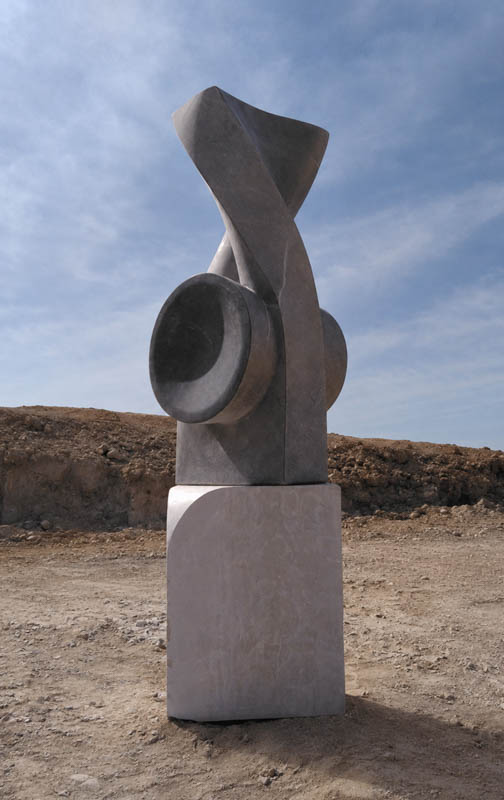
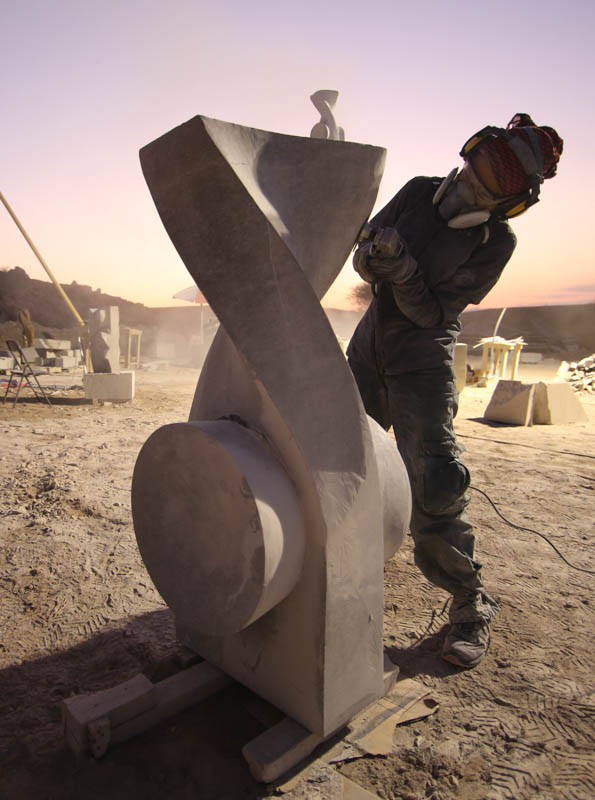
As far as I know, Poland has become a second home for you. How do you feel here as an artist? Do your works arouse interest among the Polish public? How do you perceive the local artistic environment? And do you already feel part of the Polish artistic context, or do you rather remain a Ukrainian artist creating in Poland?
Yes, over four years of war Gdańsk has become my haven and second home. Of course, I somewhat regret that, due to the lack of my own studio, I cannot for now participate in exhibitions as actively as I would like. At the same time, this period gave me the opportunity to begin passing on my experience to others. I currently work at the Gdańsk School of Art, where I lead sculpture and painting groups. In my nearest plans I also have the development of new directions—sound ceramics and 3D paper sculpture.
As for interest in my work in Poland, it is difficult for me to assess. I can only say that my Polish colleagues and students follow what I do with curiosity.
The artistic environment of Gdańsk occupies a special place in my professional life. It was here that I met people who had a significant influence on my formation as a sculptor. Above all Mariusz Białecki, Jan Szczypka, and Małgorzata Wiśniewska—I am sincerely grateful to them for their support, teaching, and experience.
Do I feel part of the Polish artistic context? It is difficult for me to answer that. I remain a Ukrainian sculptor, but I have already lived and worked in Poland for quite a long time. It is here that I now have the opportunity to teach, realize my own ideas, and continue to develop. It is not so important to me how I am defined or to which artistic context I am assigned. What matters most is being able to create new works and share experience. If my sculptures find a response in viewers—regardless of the country in which they live—that is what I consider valuable.
Sculpture symposia are a special format of work. What do they give you as an artist: professional challenge, exchange of experience with colleagues, or the opportunity to work with large stone?
For me, symposia are above all a school and an opportunity to realize myself as a sculptor. Each one is a challenge, because deadlines are fairly short and the stone is large, so one must plan each stage of work well. Of course, if you are a woman, you feel even greater pressure and responsibility to complete the work on time and at the appropriate level. After the academy, symposia became for me the only opportunity to remain in the profession and learn to work with material on a large scale.
Do you feel that full-scale war in Ukraine has affected your life and work? Different artists respond differently: some actively and expressively articulate this theme, others live through the war as if pushing it out of their works. How is it with you? Have you let the war into your stone?
Yes, the war has greatly affected my life and my work. Although in my works I usually address other themes—getting to know personality, psychology, mutual connections, balance, and support—many viewers still notice in them an echo of the war or find in the forms certain war-related associations. War cannot be erased from life, even if you live in a country where the sky is calm. It remains part of experience forever, which is why it always influences creative work, consciously or subconsciously.
For example, in the work “MEMORY,” sharp, cylindrical forms cut through the soft body of the material. For me this is a story about how the most terrible events remain in our memory like fragments embedded in the body. A fragment can be removed and in time the body will heal, but you cannot extract it from memory. That is why the most terrible events stay with us forever.
Your works remain in the public space of various countries. How would you like them to speak to people a hundred years from now and more? Do you imagine your viewer? And do you imagine that viewer in future times as well?
I would like my works to awaken in the viewer the desire to come closer, to touch the stone, to feel its energy—and also the energy and feelings I put into the sculpture. Of course, everyone will receive my works in their own way. With some they will resonate more strongly, with others more weakly. Some will pass by, hardly noticing, and some will stop for longer. That is natural—we are different, and each of us is moved by different things. Yes, I imagine my viewer in the future as well. My works will most likely remain longer than I will. And I am curious what a person who stops beside one of them a little longer will feel.
People probably ask you this often, but I will dare to ask as well. At first glance you seem an extraordinarily delicate and subtle woman in your physical build. It is hard to believe that you work with such a difficult material, and on a monumental scale at that. How is that possible? After all, a sculptor’s work is supposed to be above all very physically demanding—at least such is the stereotype. How did it happen that you chose the path of a sculptor? And why did stone become your main material?
Yes, I have been hearing this question since my academy days. Back then I was strongly discouraged from sculpture, with the explanation that, given my physical capabilities, I would not manage to become a sculptor. I believed in myself and began studies in sculpture conservation. But already within the first year I understood that this was completely not my path, and after the second year I decided to try—I entered the first year of sculpture in Lviv. Perhaps that also influenced the choice of material—if only to dispel the stereotype a little.
But truly, stone is an extraordinary medium for me. It can be very different—and it is I who decide what it will be in the final effect: soft and pleasant to the touch or sharp and rough. I want my works to encourage the viewer to come closer, to touch the stone, to stroke it or even embrace it. That is where the magic of sculpture lies for me.
In childhood, sculpture seemed to me something extraordinary. I could not understand how something living could be created from such a hard material. Only now do I understand that it is above all experience, technique, many hours of work, and understanding of the material. Then physical strength ceases to seem most important.
Gdańsk, July 2026